There are two kinds of prop firm promo code, and they carry different risks. One is published by the firm on its own website. The other circulates on affiliate sites, Discord servers and deal aggregators, and cannot be confirmed from the firm at all. Telling them apart takes about thirty seconds and is the single most useful habit in this market.
By Ingrid Solberg · Checked 8 October 2026
Two kinds of prop firm promo code and discount code
A first-party code appears on the firm’s own site — in a banner, on a pricing page, in a promotions panel. You can open the page, see the code, read the terms the firm attached to it and check the expiry the firm published. It may still expire or be geo-restricted, but its existence is not in question.
An affiliate code is issued to a partner who earns commission on referred sales. It may be entirely genuine. It may also be a lapsed code kept on a page because the page earns clicks, a code invented to look exclusive, or a code that works but gives a smaller discount than the firm’s own public offer. Funded trading is a crowded market and the referral economy around it is large. From outside, these cases are indistinguishable, and the aggregator pages competing for this search do not separate them.
How to tell which prop firm offers you are holding
Open the firm’s own homepage and pricing page and look for the code. That is the entire test.
On 8 October 2026, eleven of the sixteen firms checked for this site were advertising a discount in plain sight on their own homepage — a banner, a promotions panel or a price table with before-and-after figures. If a code is not on the firm’s site and the firm is actively running public offers, the code you were given came from somewhere else, and whoever gave it to you earns if you use it.
That is not a reason to refuse it. It is a reason not to treat the advertised percentage as a fact until the checkout shows it.
Current offers: prop firm discount codes published by the firms, October 2026
These are first-party by definition — each was read from the firm’s own page on 8 October 2026.
| Firm | Code | Published discount | Expiry as published |
|---|---|---|---|
| My Funded Futures | CLUB | 40% on any plan | none shown |
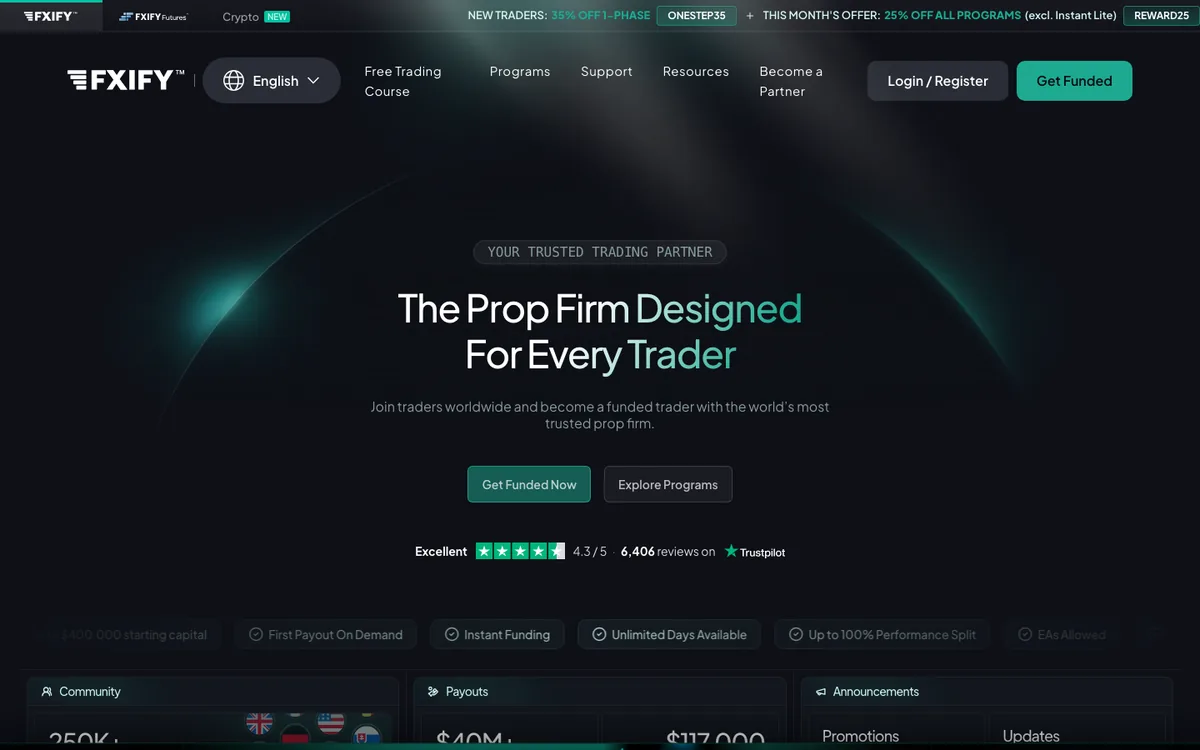
| FXIFY | ONESTEP35 | 35% off 1-Phase, new traders | 31st December 2026 |
| Take Profit Trader | NOFEE40 | 40% off for life, no activation fee | none shown |
| E8 Markets | E8ARC | “up to 50%”; table shows 30% | until 25th Oct |
| FundedNext | FNFLEX | 47% off futures accounts | none shown |
| Funding Pips | FP | 10% new users, 5% existing | none shown |
| Alpha Capital Group | NIGERIA | 40% off all accounts | none shown |
| City Traders Imperium | PORTAL15 | 15% off three programmes | until 11 Oct 2026 |
| Blueberry Funded | PRIME50 | 50% off, new users | none shown |
The complete record, including firms that publish nothing and the ones that publish list prices, is on prop firm discounts by firm, and the short version of what each firm publishes itself leads the homepage.
Why affiliate-only prop firm discounts carry more risk for a trader
Five firms in this set — HyroTrader, Hash Hedge, Topstep, The5ers and Breakout Prop — published no discount code anywhere on their own sites on the day they were read. Codes for several of them circulate on third-party pages regardless.
If one of those codes works, nothing has gone wrong. The risk is narrower and more practical: you cannot check the percentage, you cannot check the expiry, you cannot check what it excludes, and if it fails at the checkout there is no published offer to point at. You are taking an aggregator’s word for a number that the firm itself has not stated anywhere.
There is a second-order effect worth naming. An affiliate page has a commercial reason to leave a dead code up and no reason to take it down, because the click is already monetised by the time the code fails. First-party pages have the opposite incentive: a firm advertising a code that does not work generates support tickets.
Prop firm challenges and the trading offers attached to them
A promo code is attached to a specific prop firm challenge, and the challenge is the thing that decides whether the purchase was worth anything. Prop trading firms in this set sell one-step, two-step and instant-funding programmes, and the trading offers running against them are rarely uniform across the range — City Traders Imperium names the three programmes its code covers rather than claiming all of them.
This is where an unverifiable code does the most quiet damage. A percentage quoted without the programme it applies to cannot be checked even in principle, because the same firm may be running three different numbers on three different challenges at once, as Blueberry Funded was on the day this was read.
Best prop firm deals across account sizes and instant funding accounts
A coupon code is only comparable to another coupon code when both are set against the same product, and across prop trading firms they rarely are. The offers in this set cover different account sizes, different programme types and different customer groups.
No firm in this set offers a free account, whatever a coupon code promises, and account sizes are where the comparison usually breaks down. Instant funding accounts are the clearest example. They skip the evaluation entirely, so the fee being discounted is structured differently, and they are the most commonly excluded product in this market — FXIFY carves Instant Lite out of its 25% explicitly. City Traders Imperium goes the other way and names instant funding as covered.
Funded accounts at the larger sizes are where a percentage is worth the most in absolute terms and where the evaluation is hardest to pass, which is the trap set out on how prop firm discounts work. The trading offers worth most are rarely the ones with the biggest number on the banner.
What “exclusive” usually means
Deal pages lean heavily on the word exclusive. It is unverifiable from outside, and this site does not repeat the claim for any code.
In practice, an “exclusive” code is usually one of three things: a partner code with the same discount as the public offer and a different tracking string; a slightly better rate negotiated for a large affiliate; or ordinary marketing language attached to the firm’s standard public offer. The first and third are common, and in both cases the firm’s own site already gives you the same discount with none of the uncertainty.
Geo-targeting, and why your screen may differ from this page
One firm in this set makes the point unusually clearly. Alpha Capital Group’s published code on 8 October 2026 was NIGERIA, attached to a 40% offer. A code named after a country is a geo-targeted campaign, and there is no reason to assume the same banner shows to every visitor.
Everything on this site was read from one location, on one date, not logged in. Where your screen disagrees with this page, your screen is the authority for your purchase. That limitation is stated in full on about this site, and it applies to every row in every table here.
Futures prop firm discounts at FundedNext and My Funded Futures
Where a promo code comes from is one axis. What it is attached to is another, and the two interact. On 8 October 2026 the futures prop firm discounts in this set were the deepest and the least restricted — 40% on any plan at My Funded Futures, 47% on futures accounts at FundedNext, 40% for life plus no activation fee at Take Profit Trader.
The forex offers clustered lower and carried more conditions, and the crypto picture was different again: the crypto-native firms published nothing at all. Full detail is on forex prop firm discounts and crypto prop firm discounts.
That pattern is useful for judging an unverifiable code. A coupon claiming 50% off at a firm whose whole category discounts at 15% is worth more scepticism than one claiming 40% in a category where 40% is the going rate.
How to apply a prop firm promo code and verify what it did
Open the checkout, select the exact product, enter the code and read the discounted line against the list price. That is the only test that settles anything, and it is the step this site cannot do for you.
What to check before paying:
- The product. Codes are routinely restricted. FXIFY’s 25% excludes Instant Lite.
- The customer type. Funding Pips publishes 10% for new users and 5% for existing ones; the same code gives different answers depending on who is holding it.
- The account size. A discount on a $100K evaluation is a much larger absolute saving than on a $50K one, and a much harder evaluation to pass.
- The expiry. Three of the eleven published offers carried end dates, and one of those had three days left on the day it was read.
Current offers, and what “best prop firm deals” usually means
Deal pages rank prop trading firms by headline percentage. On the evidence in this set, that ranking would put E8 Markets near the top on a claimed “up to 50%” that resolves to 30% on every product in the firm’s own price table, and it would rank Take Profit Trader’s 40% below it despite a permanently waived activation fee attached.
The honest version of “best prop firm deals” has to account for what the offer covers, what it excludes, how long it lasts and what the list price was before it applied. Only two firms in this set publish enough information for that comparison to be made at all — the prices are on the firm-by-firm record.
Payouts do not enter into it. No code changes the profit split, the withdrawal schedule or any trading rule on a funded account, whichever kind of code it turned out to be.
Frequently asked questions
Is an affiliate prop firm promo code a scam?
Usually not. Most work. The problem is that nothing about them can be checked before you try, and a failed code at a checkout has no published offer to appeal to.
Should I use the firm’s own code instead of an affiliate one?
If the firm publishes one, it is the one you can verify. Where an affiliate claims a better rate than the firm’s public offer, the checkout is the only thing that settles it.
Why does this site not list codes for every firm?
Because it lists what firms publish. Five of the sixteen checked publish nothing, and inventing a percentage for them would make this page exactly like the ones it is trying to be better than.
How do I check a code before paying?
Put it in at the checkout and read the line item, not the banner. The discount either appears against the price or it does not, and that is the only test that settles anything.